
Design of Ornaments and Gothic Lolita (in Anime Style)

Introduction
How many people don't love Halloween? It's the perfect occasion to try out some "spooky" ideas and dress your characters in the most ostentatious and extravagant clothes. If you still don't know what to draw for Halloween, I invite you to read this tutorial where I will present the complete process of an illustration set inside a Gothic-style hallway, featuring one of my characters from my webtoon "Wanderlust Artemis," Essie. And the most fun part: In anime style! I will be using CLIP STUDIO PAINT PRO, and the brushes used will be detailed throughout the tutorial.
Concept Art and Sketch
A custom I have is concept art, which consists of trying out different compositions for an illustration until you find something you like. (Although it's not a mandatory step if your illustration is simple or if you have a clear idea of what you want to draw) Concept art doesn't need to be very detailed; it just needs to show the intention you want to achieve with your illustration.
In this case, my goal is to achieve a "sense of mystery," in the sense of exploration. Sketch ① gives the feeling that my character is welcoming you to a haunted mansion; while option ② makes it seem like the character is exploring the haunted house. Both align with the "mystery" concept, but body language makes the difference. I lean towards option ②; as, in my opinion, it more easily shows the intention of "exploring the unknown" and I like it more for its dynamism.
Once the decision is made, we proceed to sketch the chosen idea:
Important: Gothic Lolita outfits consist of many details and lace, but it's not necessary to sketch everything (only what's essential), as we will use brushes that will save us work. The same applies to the background hallway; we will use materials and brushes to save time on outlining.
Quick Linework with Detail Brushes
Now that we have the sketch, we will draw the Linework, like this:
In anime, linework consists of thin, simple lines, so don't worry about too many details; just trace the simple shapes. The important thing is that the lines are thin. Also, don't resort to black: anime doesn't usually use black as it's a very heavy color, so I recommend grays or browns, depending on your color palette. But we'll see that later.
As you may have noticed, I haven't outlined the entire sketch; I've left the wall, the lantern, the dress lace, and the veil for the end. The reason? I found some brushes we can use to save time:
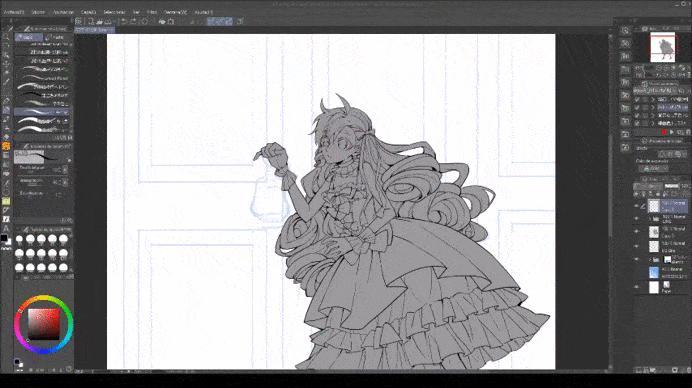
For the lantern, I used the decoration brush attached previously. On a layer above the Linework, I traced the model and completed the design according to what I had sketched.
Also, it's possible to use ruffle brushes to make the work even faster (although I generally prefer to draw them myself).
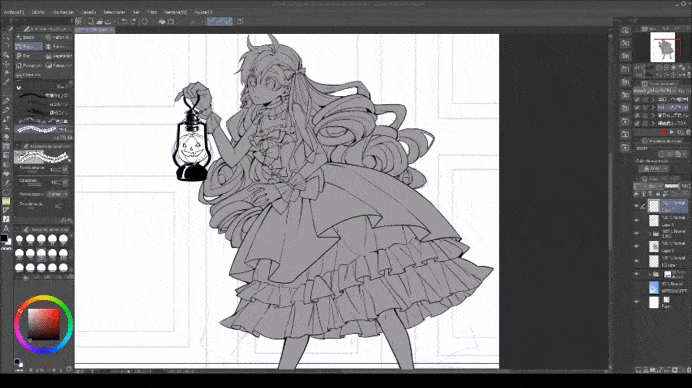
Now that our Linework is "ready," we will select the layers and combine them into one. Then, in [Edit->Convert brightness to opacity], we will be left with only the lines. Like this:
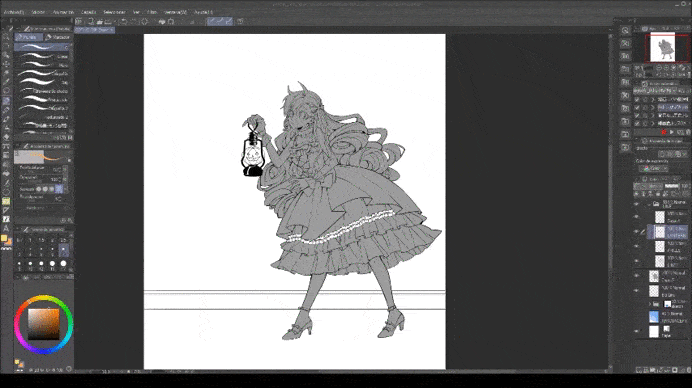
The next step will be to add color.
Color - Background
Now that we have the base color for the entire illustration, it's time to work on the background. (I also changed the Linework color; it's now dark brown). A simple way to design ornate walls is with rectangles, outlines, and decoration brushes. For example, (I'll do it on a separate canvas for better visualization) draw a series of rectangles, one inside the other. (You can use the [Figure->Rectangle] tool or [Ruler->Figure ruler], whichever you find more comfortable). Then, draw all the diagonals to give a sense of depth.
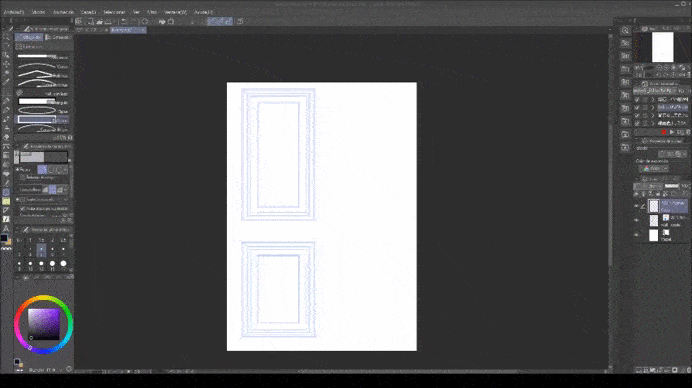
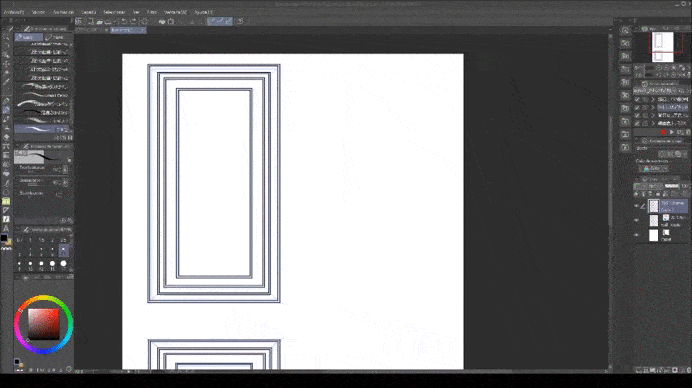
Basically, it's 3-4 rectangles, one inside the other:
Each of these rectangles should have its own offset, like this:
Now all that's left is to connect the diagonals of each frame and color:
(*) We are only making 1 section of the wall because we can later copy and paste the design into the background.
This is the fun part: ornamenting. With [Ruler->Figure ruler], we trace the shape of the frame, select the brush, and let the magic happen.
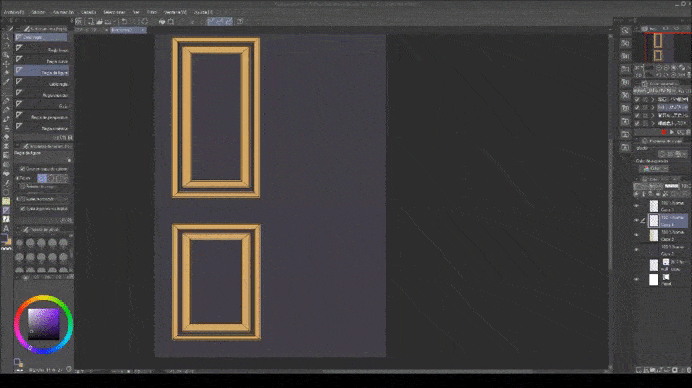
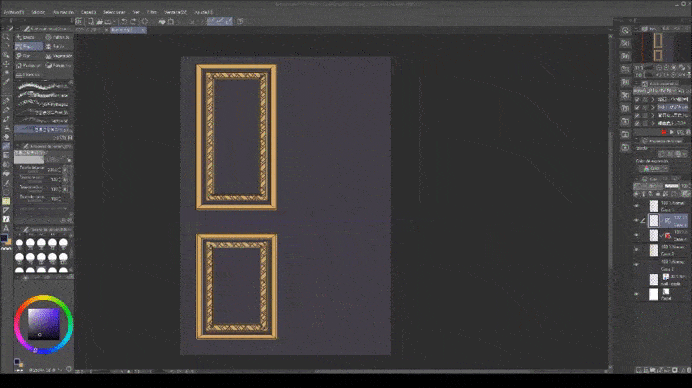
You can make as many designs as there are brushes. Once you've decided on your design, copy and paste the layers into your illustration. Mine turned out like this:
And we copy and paste the wall design to fill the succession:
These are the brushes that could help you:
I have also uploaded the wall model I created in this illustration to ASSETS, in case you want to use the same design:
Color - Gothic Lolita Outfit
We will continue with Essie's outfit. All we have to do is fill the dress with lots of lace and accessories, something typical of Gothic Lolitas. You can use as many references as you like.
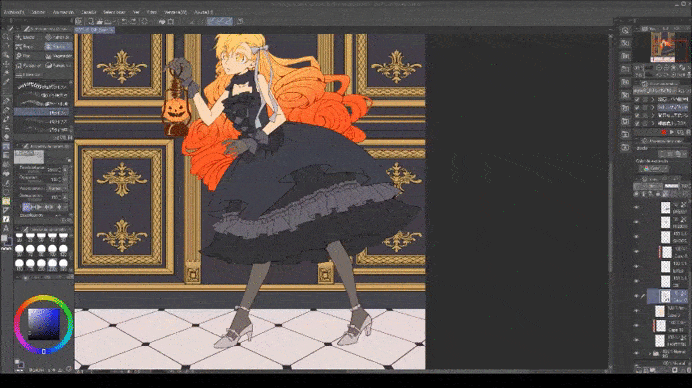
I also added pearls to the outfit and as necklaces to make the design more ostentatious.

These are the brushes used previously:
Only the veil remains; I will draw it on a new layer, above the character's Linework.
Then, on a "Multiply" layer, we color the veil:
Next, from the Materials folder, we select the lace texture we like and drag it to the drawing.
Then, on a clipping layer, scale the image if necessary:
Color - Light and Shadow
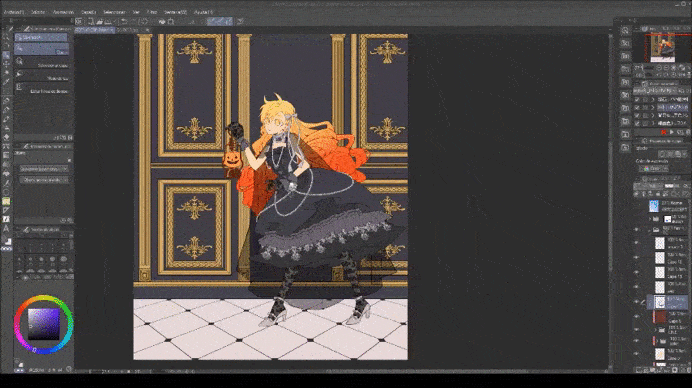
The base of the illustration is ready for shadows. In anime, shadows are simple and flat. The easiest method is to shade with grayish-blue (or reddish, depending on the illustration) on a new "Multiply" clipping layer, set the opacity between 40%-50%.
For light, I use yellow-orange color and set the layer to "Add (Glow)" with 30%-40% opacity.
Also, special effects are very common in anime-style illustrations. It might be something "extra," but use them whenever you can! It adds that magical touch! It will look like sparkling dust!
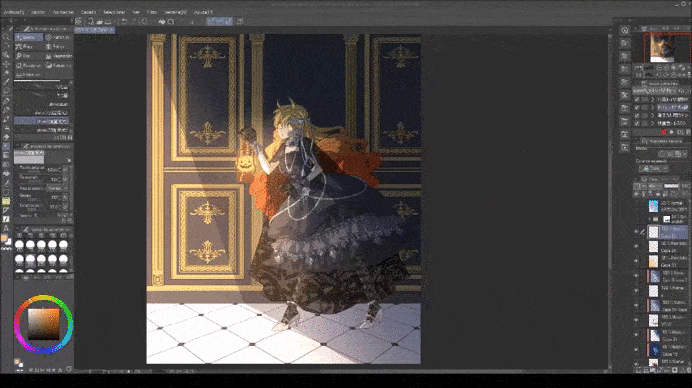
Now, let's combine the background layers and, in [Filter->Blur->Gaussian Blur], we blur the background.
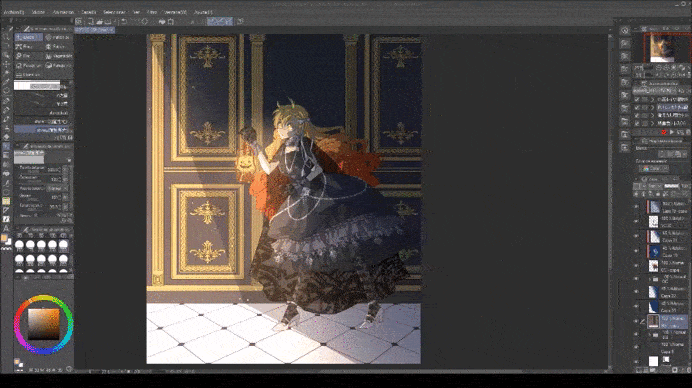
The further away the background is, the more blur you should apply. Approximately 20-40 pts. Since the wall is close to our character, I only applied 20 points of blur.
Final Steps
Our illustration is almost ready! All that's left is to combine all layers and make 2 copies of it. With the top layer, we will blur again. The more you blur, the more "magical" or "glowing" it will appear.
Finally, we set the blurred layer to "Hard Light" and change the opacity to approximately 50-60%.
(*) Optional: In [Edit->Tonal Correction->Color Balance] you can edit the colors a bit.
And done! I hope this tutorial has helped you understand how to design gothic ornaments faster and how to easily create anime-style illustrations!
Thank you very much for reading and Happy Halloween in advance!!
I'll attach some of my social media links in case you're interested in seeing more of my drawings!
Users who liked this post




Comment