
Magic! Animate with scatter effect

-
 MVP ◆This user has contributed greatly to the management of the community, by posting many great responses to the questions asked. Once every three months, MVPs are determined based on the points earned during that period and will be recognized accordingly.
 -
 New Valuable Player (NVP) ◆These are the next-best contributors to the community after MVPs. This is awarded to users who have not yet won an MVP award, based on the number of points they have earned.
 -
 Official Expert ◆Chosen out of all MVP awardees, who are already proof of excellence, this is a testimony of outstanding correspondence in the community. After careful screening, they are appointed by CELSYS and assume their position.Note: Formally called “Evangelists”
 -
 CELSYS official moderators ◆Moderators are official CELSYS staff members who are fluent in Japanese as well as various other languages. As moderators are not experts on software or creative work, they will not be able to directly answer your questions. However, moderators will provide communication and language support to ensure that everyone can smoothly communicate with each other.
 -
 CELSYS officialThis is the official administrator account.
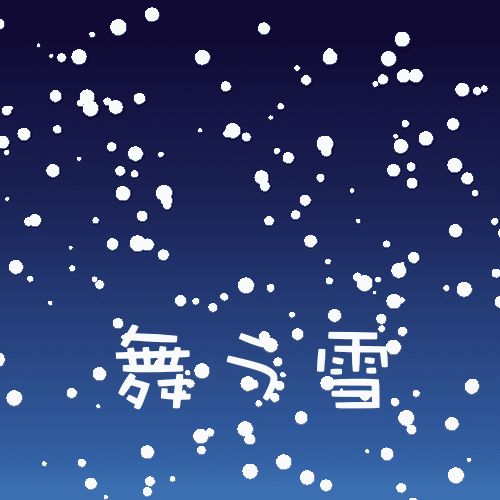
A place where a balloon containing a scattering effect is rotated by chance
Because an unimaginable weightless world has spread
I thought I'd try TIPS
Easy to make!
Draw the scatter effect brush on the vector layer
Just add a keyframe and rotate
Once you have a brush, you can create a GIF animation in 5 to 10 minutes.
I will create it immediately
First create a 500x500px illustration canvas
A GIF animation can easily exceed 10MB
sorry for this size
draw a circle with a ruler
Add vector layer to canvas
show the grid
snap to grid
Draw a circle on the canvas with the ellipse of the figure ruler
G pen for now
Uncheck "Pen pressure" in the influence source setting of the brush size of the G pen
Draw a circle along the canvas ruler
Add a gradient layer to make it a night background
Select the vector layer again in the layer palette
Sub tool selects objects
Display sub tool detail palette
Change the main color to white (snow color)
Select "Brush size" in the sub tool details item
Set the brush size to 600 (px)
Select "Stroke" in the sub tool details item
Select "Fixed" on the left of the four "Gap" icons
set the number to 100
Setting the scatter effect
Select "Scattering effect" in the sub tool details item
Check "Spray Effect"
Set "Particle Size" to (16)
Check "Random" in "Influence Source Settings"
I set the number to (20)
"Scatter Deflection" set to (-50)
"Particle Density" is set to (6)
Create a timeline
Show timeline palette
Press the "New Timeline" icon on the left side of the timeline palette
set new timeline
Frame rate to (24)
Set the playback time to (6 seconds + 0 frames) and click "OK"
A 6 second timeline is created
key frame
Press the "Enable keyframes for layer" icon on the timeline palette
The icon for "interpolate keyframes"? and select "Keyframe to create: constant velocity"
Press the "Add keyframe" icon on the left as it is
A keyframe has been added to the beginning of the timeline
Press the "To the end" icon of "Move frame" on the timeline palette
Display the "Tool Property" palette
Enter "360" for "Rotation angle"
A keyframe is added at the last frame of the timeline
Drag the added keyframe to move it to a frame outside the display
The handle of the canvas will tilt slightly, which is a good sign
work done
Export this as a GIF animation
Select "Animated GIF" from "Export animation" in the "File" menu
width (500) height (500) px
Frame rate (24) fps
Loop count (infinite)
Check Dithering and click OK
Finish!
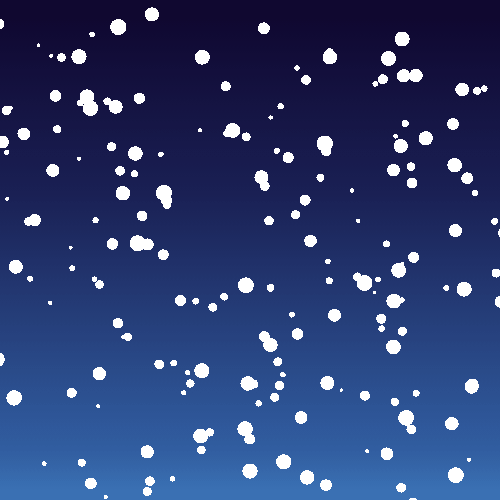
recreate from settings
I will make a girl stand in the falling snow
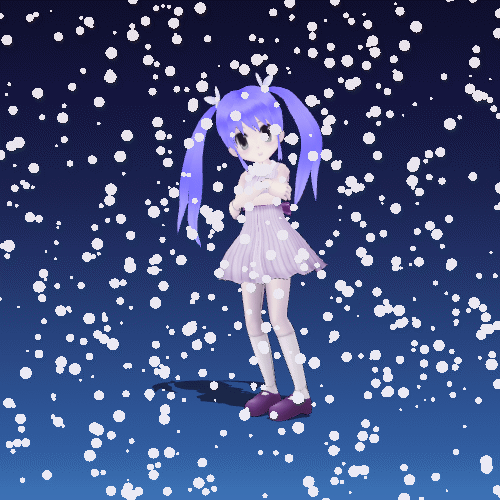
it looks cold
little improvement
I just thought of it, so I added a little
It's not just dancing, it's moving down while dancing
I duplicated the layer into 4 and arranged it to move from top to bottom
Some snow is rising, but overall it is slowly falling
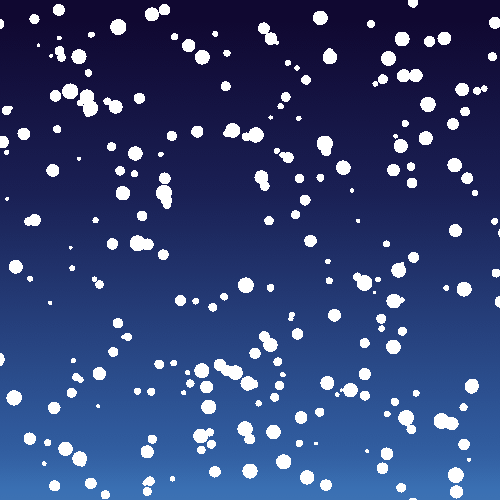
Duplicate the scatter effect layer to 4 in the layer palette
Sub tool selects objects
Click the first frame of the bottom layer of the four layers in the timeline palette
Set the "Y" value of "Position" of "Transformation" on the tool property palette to (250)
I think it's originally (250), but please confirm
Click the first frame of the layer above it on the timeline palette
Set the value of "Y" in the tool property palette to (750)
Click the first frame of the second layer from the top of the timeline palette
Set the value of "Y" in the tool property palette to (-250)
(-) There are times when minus is not entered properly
Please be careful
Click the first frame of the top layer of the timeline palette
Set the value of "Y" in the tool property palette to (-750)
Display the end of the timeline by pressing the "to end" icon in the timeline palette
Drag the blue bar at the top of the timeline to the right by one frame
Drag the playback range of the four layers to the right by one frame.
The playback range can be changed by dragging the small square on the right
(*In the attached image, one frame has already been stretched.)
in the same way
Click the last frame of the bottom layer that you duplicated in the four on the timeline palette
Set the "Y" value of "Position" of "Transformation" on the tool property palette to (750)
Click the last frame of the layer above it in the timeline palette
Set the "Y" value of "Position" of "Transformation" on the tool property palette to (1250)
Click the last frame of the second layer from the top of the timeline palette
Set the "Y" value of "Position" of "Transformation" on the tool property palette to (250)
Click on the last frame of the top layer of the timeline palette
Set the "Y" value of "Position" of "Transformation" in the tool property palette to (-250)
lastly
Move the playback range back one frame to the left
Write this out and voila
Theme recovery!
and
"Magical Animation"
A cat witch wears seven colors of snow
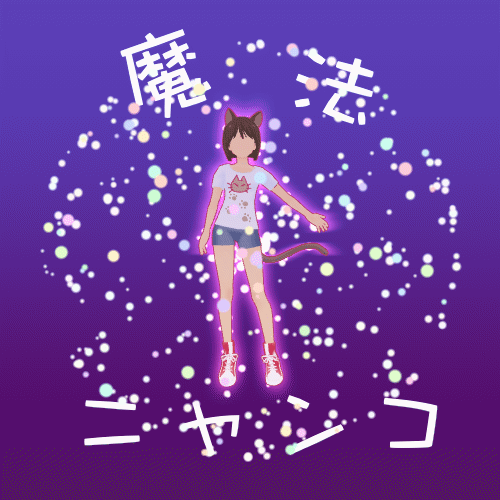
It looks like it's covered in spherical snow
Nyakoko is just sandwiched between vector layers with a scattering effect.
A mysterious effect that looks three-dimensional was born
a truly magical animation
So far
Next is the magic that "taiyaki dances"
Users who liked this post






Comment